Wednesday, July 31, 2013

My Books About Libraries


You can't always tell a book by its cover,
but you can always tell a person by his books.

From
"The Books People Read" by Edward Wegman,
The UNESCO Courier, June 1972


Could I have been a librarian in a previous life?  That would explain why I have so many books about libraries.  I have books about poor men's libraries, old libraries, great libraries, proprietary (subscription) libraries, public libraries, research libraries, institutional libraries, and private libraries. And I also have a shelf of books about the Library of Congress.

I will display the front covers of some of my books about libraries. And if you click on the links above the images, you will find out more about the books, including, in some cases, provenance information. From some of the books I will post passages I think you might find interesting. And finally, at the end of my blog post, I will provide a link to the Library Thing listings of all my books about libraries.


The Story of a Library


The Library of a Bibliomaniac (?)


How to Build A Poor Man's Library


How To Build a Poor Man's Morgan Library


The Memory of Mankind


The Medieval Library


Great Libraries


Library: The Drama Within


Library: An Unquiet History


Once upon a time, in the early days of the British colonies in America, there were libraries and there were men who bought books. Neither in size nor in wealth could they compare with their latterday successors; yet, pioneers in a vast, bookless wilderness, they began the flow of books to American library shelves which has grown into a torrent. The books they bought were not 'rare books' in the accepted sense of the word today. They were texts the colonials wanted and needed; they were second-hand books which came to them through the regular channels of bookselling. That some of them have become 'rare" and hence valuable beyond their usefulness for mere reading, has been due to the passage of time and the widening of the rare book field. That some of them are association copies of unusual distinction is an accident of dispersion, for no known 18th-century American purchaser paid a premium for arms on a binding or a signature on a title-page. I doubt very much that even the best informed among them were conscious of what they owned in terms of provenance.


The above quote is by the librarian, author, and bibliophile, Edwin Wolf 2nd. It is from an offprint of an article from the autumn 1960 issue of The Book Collector. The title of his article was "Some Books of Early English Provenance in the Library Company of Philadelphia." Edwin Wolf 2nd sent this very pamphlet to Donald and Mary Hyde. The coffee stains, by the way, are not mine.


Benjamin Franklin founded the Library Company of Philadelphia in 1731. On its website, it touts itself as "America's oldest cultural institution."

The very first sentence in the next book identifies Harvard Library, founded in 1638, as the oldest library in America.


The Library in America


Surprisingly, in The Story of Harvard, by Arthur Stanwood Pier, Boston, 1913, the author makes no claim that the Harvard Library is the oldest library in America. In fact, the book is rather thin on information about the Harvard Library.


The Story of Harvard


Heading my way is what appears to be a better book about the Harvard Library, a special issue of the Harvard Library Bulletin, a "Description of an Exhibition" written by Kenneth E. Carpenter, and published in book form in 1986:


Another old library in America is the Redwood Library, Newport, Rhode Island, founded in 1747. In the book below, a 1764 catalogue of the Redwood Library, the library is touted as "the third proprietary library in America (Following the Library Company of Philadelphia, 1731; and the Library Company of Darby, Pennsylvania, 1743)."


The Redwood Library


Still another old proprietary library is the New York Society Library, founded in 1754, which touts itself as the oldest library in New York City.

New York Society Library


The Boston Public Library, founded in 1848, is the first municipal public library in America to lend books.

Boston Public Library


Being born and bred in the suburbs of New York City,  I will always have a soft spot for the New York Public Library, no matter how old or young it is.


NYPL


NYPL Rose Main Reading Room


Yes. There are many different kinds of libraries. What you may not know –– I didn't –– are the names of the different library building types. The two-volume set below is the dissertation submitted by Kenneth Alan Breisch in 1982 in partial fulfillment for his Master's Degree from the University of Michigan.


Small Public Libraries in America


The complete title is Small Public Libraries in America 1850-1890: The Invention and Evolution of a Building Type,University of Michigan, 1982. In his Preface, Breisch notes that two studies on the history of small libraries in America had previously been published. But "both studies, however, were written by librarians and neither, therefore, attempts to place individual library buildings within the general context of American architectural history."

The first volume of this set provides a brief survey of European library architecture prior to 1850, a section on the American library building prior to 1860, and explanations of the different library building plans of the middle to late 1800s: the T-Plan, the Italianate Style, the Second Empire Style, the Richardson Style, the Poole Plan and several more.

The second volume of this set contains over 400 illustrations of library plans and structures.  But the quality of the images, however, leaves something to be desired:


Here are two books by Snead and Company Iron Works, Jersey City, New Jersey, which provided book stacks and shelving for libraries:


Book-Stack and Shelving


Library Planning


Both editions can be viewed online:  1908 edition; 1915 edition.  The illustrations are well worth viewing.


Here's an 1893 catalog from the Library Bureau from which librarians ordered library fixtures and supplies.


When it comes to the construction of library buildings, one must remember Andrew Carnegie. "Up to the year 1907 Mr. Carnegie's library gifts had provided for 1636 library buildings, covering grants of $44,545,7422...(Koch,vii)."


Carnegie Libraries


And here are some of my books about institutional and research libraries:


William L. Clements LibraryLibrary Dedication


Houghton Library, Harvard


Here's a book written by George Parker Winship about the John Carter Brown Library, a sampling of which I include below:

John Carter Brown Library


The Librarian's room occupies the middle of the eastern side of the building, opposite the entrance. In this room the traditions of the days when the collection was a gentleman's private library are preserved. All of the furnishings, except the modern letter-file and the electric-lighted chandelier, came from the library room at Mr. Brown's homestead. In the old mahogany cases, the original editions of the Columbus Letter and the Vespuccius tracts, the Jesuit Relations, the writings of Roger Williams, and the volumes of De Bry, each in its brilliant binding, still hold the places to which John Carter Brown assigned them. If he could revisit his collection in its new home, he would find these friends he was fondest of, where he left them. His favourite chair has the place of honour at the table on which he examined all of the purchases of the later years. The old lamp has been refitted for an electric current, but no push button has stolen its dignity from the bronze table bell. The rug and the anitmacassars are the same as in the founder's day.


And here's a passage by Lawrence C. Wroth from the Introduction of a book printed as a tribute to John Nicholas Brown, John Carter Brown's grandson:

Libros Virumque Cano


In the later months of 1924 the new Librarian of the John Carter Brown Library found himself in a position of discomfort. For a year or more he had been living a life of enthrallment through encounters repeated almost daily with one after another of the great books of basic American interest, books he had heard about and read about but never before had seen or held in his hands. This was happiness undiluted, but on another account he was distressed. Many times he had been told flatly and emphatically by the dominant member of the Committee of Management that the John Carter Brown Library was perfect and complete as it stood, and that not a penny was ever thereafter to be spent on the purchase of a book. The point of view of our boss man did not prevail to its bitter conclusion. The sympathetic connivance of another member of the Committee had made it possible somewhat to ameliorate the full rigor of the interdict, but still it remained in force.
It is to state an undisputed thing in a solemn way to say that no library ever has been perfect or ever could be. The year of daily association with the great collection had increased my admiration for it at the same time that there had been revealed to me the absence from it of many single works of consequence and of an astonishing number of groups hardly recognized or at best recognized and passed by with indifference or complete forgetfulness.
But happily a change of radical character in the Library's collecting policy was about to occur. There was nothing of the dramatic in the event except to me; to me it was drama in the highest sense. One day in the late months of 1924, Mr. John Nicholas Brown, then a young man of some twenty-four years engaged in graduate studies at Harvard, came into the Library to pay his first visit in my time as librarian. He displayed more than a passing interest in all our concerns, large and small, and as he was about to leave he said he would be glad to help in the purchase of books. I said that was wonderful for only that day we had been offered four Italian and French tracts, three of them unique, displaying the unfriendly attitude of continental Europe toward Francis Drake, "El Drago," the English Protestant hero. "I think we should buy them," he said. Thus began a most notable exercise in book collecting, a selfless exercise on behalf of an institution formed by the collector's grandfather, John Carter Brown, and his father, the first John Nicholas Brown, and now the possession of Brown University.... (9,10).


And then there are my books about the Library of Congress:


LOC:  Picture Story


Treasures of the Library of Congress


LOC: Education


LOC: Inspiring the World


I have three  Library of Congress Catalogues: 1861, 1864, and 1869.


I have over thirty years' worth of Annual Reports of the Librarian of Congress."  One of these days I may write a separate blog post about my Library of Congress books.


I have a number of books about the private libraries of book collectors and authors whose books I collect.


The Private Library


The oldest private library I have is the 1609 catalogue of the Lumley Library, printed by the British Museum in 1956:

The Lumley Library


Robert Hoe


John Quinn


Harry B. Smith, A. Edward Newton


P.K. Foley, Paul Lemperly, Amor L. Hollingsworth


Wilberforce Eames


Herschel V. Jones


Theodore  De Vinne


Four Private Libraries


Frederick B. Adams, Jr.


History of Books and Libraries


Charles Lamb


Virginia Woolf


Frank S. Streeter, Thomas W. Streeter


H. Bradley Martin,  Abel E. Berland


Frank J. Hogan, Barton Currie, William G. Low


Moncure Biddle


John F. Fleming


SJ: Fleeman, SJ: Greene


SJ: Oak Knoll


JB:Oak Knoll, JB: Auchinleck


Four Oaks


There are some of my books about libraries we have not viewed in this blog post. You can view them here: Some Libraries We Have Not Visited.


Thank you for viewing and visiting my books about libraries.


Saturday, June 29, 2013

Cataloguing And Recataloguing the Boswell Library


I have always considered myself to be a Samuel Johnson/Mary Hyde Collector. But now I see quite a few books by or about James Boswell on my library shelves. So maybe I have become a James Boswell Collector as well.

One book I can't wait to add to my library is Boswell's Books, soon to be published by my friend Terry Seymour. His book is a study and a catalogue of books formerly owned by James Boswell (1740-1795) and other members of his immediate family. And just to entice us, Terry wrote "An Appendix to Boswell's Books," an article which appeared in the March 2013 issue of the Johnsonian News Letter (JNL).


But Terry Seymour's JNL article caused me to recatalogue the Boswell Library on Library Thing. Yes. I am no stranger to Boswell's books, having spent almost four years cataloguing them. In October 2008, I invited Dave Larkin, a booklover from the Cape Cod area, to help me catalogue James Boswell's library. Dave had previously invited me to help him catalogue Samuel Johnson's library on Library Thing. Joining us was Anna Ritchie, a Scottish lass who was working in the Netherlands.

The catalogue we would use, Bibliotheca Boswelliana, was part of the Sale Catalogues of the Libraries of Samuel Johnson, Hester Lynch Thrale (Mrs. Piozzi) and James Boswell With an Introduction by Donald D. Eddy, Oak Knoll Books, New Castle, Delaware, 1993. My copy of this work was a set of unbound sheets, which was perfect for scanning parts of the 1825 catalogue and sending them to Dave and Anna in PDF files.


In his Introduction, Donald D. Eddy quoted James Boswell:

Dr. Johnson advised me to-day, to have as many books about me as I could; that I might read upon any subject upon which I had a desire for instruction at the time. "What you read then (said he) you will remember; but if you have not a book immediately ready, and the subject moulds in your mind, it is a chance if you again have a desire to study it" (Life III 193).


Immediately below the quote, Eddy wrote: "The following catalogue shows that Boswell heeded Johnson's advice remarkably well."

I would later learn that what we were cataloguing was not the library of James Boswell the Biographer (1740-1795), but rather the library of James Boswell the Younger (1778-1822. Also included in this auction were books belonging to the biographer's other son, Sir Alexander Boswell (1775-1822). So with foot in mouth, sometime before the 22 May 2009 deadline, I submitted the following announcement to the JNL, which appeared in the Sept 2009 issue:


James Caudle, Associate Editor of the Yale Editions of the Private Papers of James Boswell, read my announcement in the JNL –– and probably chuckled! But in the weeks, months, and years to come, James Caudle would supply me with real catalogues of James Boswell's library; enough catalogues which, in Dave Larkin's words, "would keep us busy for the next fifty years."

It took us thirteen months to catalogue the books listed in the 1825 Auction Catalogue. It took us another thirteen months to catalogue the books listed in the 1893 Auchinleck Sale Catalogue.


It took me two months to catalogue the books listed in the 1810 Catalogue of Greek & Latin Classics in the Auchinleck Library.


It took me six months to catalogue the books listed in the C1770 Catalogue of Books Belonging to James Boswell Esq.


It took Dave Larkin eight months to catalogue the Boswell books listed in the 1916 Sotheby Sale.


It took me six months to catalogue the Boswell books listed in the 1917 Dowell Sale.


On August 30, 2012, after cataloguing Boswell's Curious Productions (chapbooks), I declared the cataloguing of the Boswell Library complete.

And yet, I was recataloguing Boswell again this month! You see, the appendix that Terry included in his JNL article was a detailed listing of all 290 entries of the 1810 Catalogue of Greek & Latin Classics in the Auchinleck Library. When I catalogued the 1810 Catalogue on Library Thing in 2011, I only came up with 279 entries. So this month I counted each entry in the catalogue James Caudle gave me and, sure enough, there are 290 entries. And after a day and a half, I found and catalogued the entries I missed the first time around.

I have to say I am proud of our achievements in cataloguing the Boswell Library on Library Thing, and even enjoyed recataloguing it again. But one thing that frustrated me, particularly when cataloguing the 1893 Auchinleck Sale, was the number of books that were not listed by title in the lots, but which were represented by that dreaded phrase, and others. By my count there were at least 436 books not listed by title in the 1893 Auchinleck Sale.

Terry Seymour's book, Boswell's Books, will include many of the books listed under and others. Terry went one step further, acquired the bookseller catalogues of the purchaser's of the 1893 Auchinleck Sale lots, and identified books that were not listed by title in the auction. And to sweeten the pot even more, Terry traced the provenance of many of the books, from the auction and bookseller catalogues to their current location in institutional and private libraries. Take a bow, Terry!

Yes. I can't wait to add Boswell's Books to my library.

Wednesday, May 29, 2013

His Dictionary?


There are millions of books fit only to read, but there are
a few that should be treasured as the relics of the saints.

Harry B. Smith
A Sentimental Library, 1914


I've been researching the NRA and the Second Amendment for the past few months. But I got sidetracked when I came across Justice Scalia's majority opinion (5-4) in the landmark Second Amendment case, District of Columbia vs Heller. To better explain the meaning of the words of the Second Amendment, Justice Scalia cited definitions from a contemporary dictionary, the 1783 Fourth Edition of Johnson's Dictionary.

Well this gave me an excuse to grab my favorite volume of Johnson's Dictionary down from the shelf and look up the definitions myself. And that's when I got sidetracked.


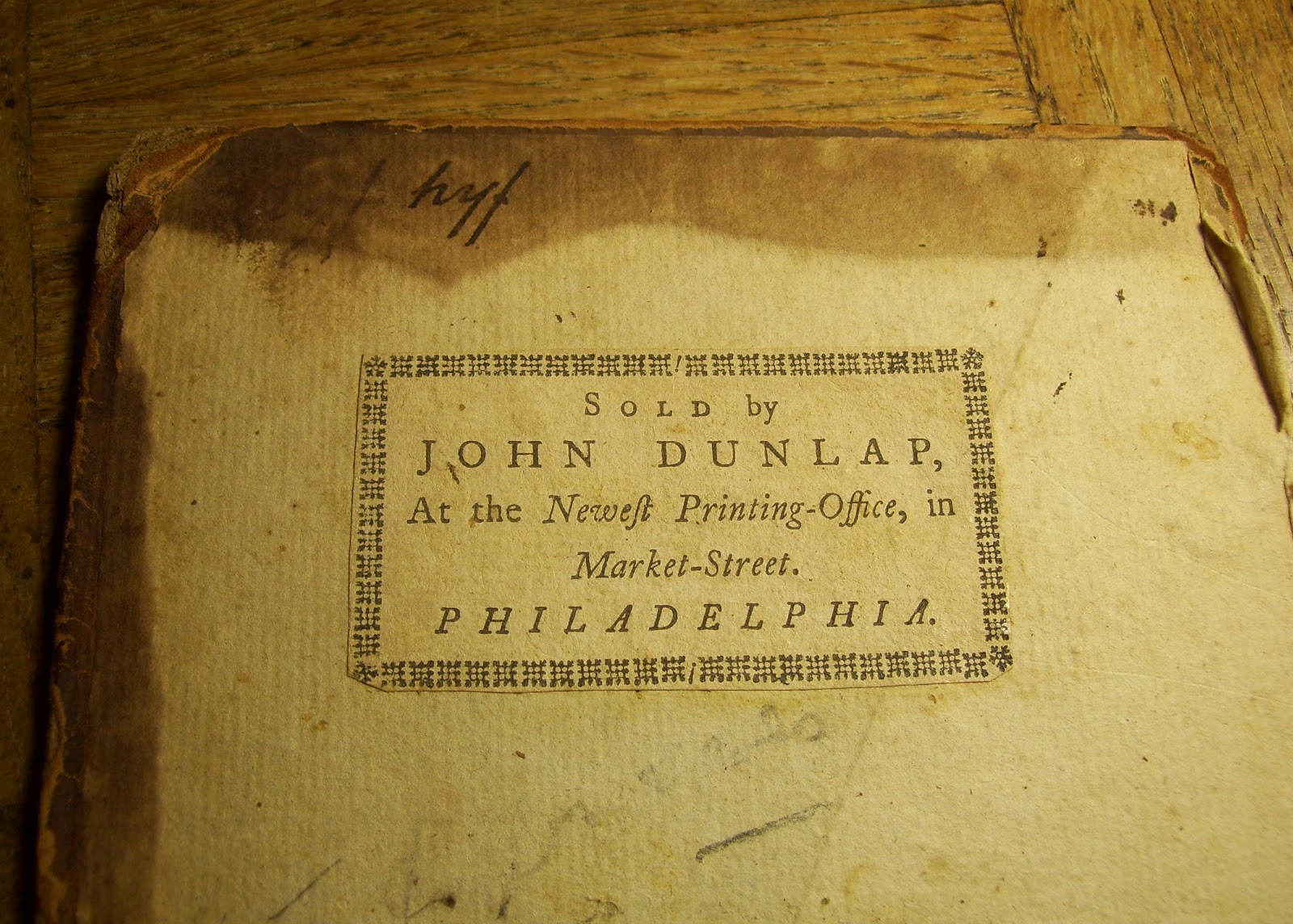
My favorite volume of Johnson's Dictionary is Volume I of a married set of the 1770 Fourth Abridged Edition. My copy of Johnson's Dictionary trumps the copy Justice Scalia referred to because John Dunlap, the printer of the Declaration of Independence, was the bookseller who first sold it.


The front cover of this volume is detached, and will remain that way, but I still consider this volume to be one of the treasures in my library.


This book was formerly owned by Edward Stair, who signed his John Hancock on the front pastedown, below where an unknown hand overwrote "2 vols."


I found no information on Edward Stair, but I'm still researching. I don't think Edward Stair was the original owner of this dictionary. But he may have acquired the book in the late 1700s or early 1800s. The original owner signed his John Hancock in the top right-hand corner of the front free end paper (ffep) and the top right-hand corner of the preface page. These corners, however, and the top right-hand corner of the title page as well, were either torn off, worn off, or cut off. Although the edges of the first few pages in the front and rear of the book are browned, the paper still feels strong, leaving me to wonder if someone wanted the signatures on the pages.

ffep


If the corner of the ffep was torn off, why did the scoundrel leave the descenders of the first two letters of the first word, possibly the first name of the original owner? Clearly visible below the descenders, the original owner wrote the words, "his dictionary." And below that, he wrote the numero sign, "Nº 1," but with a dash and a period added below the zero glyph.

Title Page


If there was a signature written on the title page, it was cleanly excised.


Preface


Clearly visible on the preface page are the descenders of what could be the first two letters of the first name of the original owner. The letters appear to be either "Jo, Yo," or "Go." The letters are definitely not the first letters of the name of one of the former owners, Edward Stair.

There may not have been anything written in the top right hand corner of the title page; but the year, 1770, was written in pencil near the bottom of the page by an unknown hand.


The only other writing in the book is on the front pastedown. In the top left-hand corner, an unknown hand wrote the letters "hy" and what could be the letter "f." The letters could be a bookseller code. There are impressions in the paper of other letters written in this corner but they are unreadable.


In the top right-hand corner of the front pastedown, the letters "ns" are written. Barely visible are impressions on the paper of the letters "Johnso," which preceded the letters "ns."


Directly below Dunlap's bookseller ticket and above Edward Stair's signature, an unknown hand wrote "J. D____? 2 vols."


Now I have had this particular book since January 2004, and I never got to first base in identifying its original owner. But, I tell you, I had an Epiphany when, while researching the definitions of the words of the Second Amendment, I saw the exaggerated stroke of the descender of the first letter. It reminded me of the way John Hancock signed his name on the Declaration of Independence.  

John Hancock, the President of the Second Continental Congress, was the founding father who directed John Dunlap to print the broadsides of the Declaration of Independence....Could this be his dictionary? No Way! Well ... highly unlikely. As you will soon see, the "J" the original owner inscribed in his dictionary is not the usual John Hancock "J." And it may not even be a "J" at all.

I have been down this road twice before. I have a book I thought belonged to George Meredith because someone wrote "Geo Meredith's copy..." on the ffep. But an expert on George Meredith told me the author would never identify one of his books like that. And then there was a book in which a note on the rear pastedown recorded that General Andrew Jackson bought the book in Washington District on Dec. 24, 1828. But on this very date, Andrew Jackson was 600 miles away burying his wife Rachel at the Hermitage in Nashville.

Twice bitten, thrice shy. Yet, I'm a glutton for researching almost anything, even seemingly lost causes. But I wish I had more to work on than two words, the descenders of two letters, and the phrase, "Nº 1."

The first things I wanted to research was whether there was any record of John Hancock ever having a copy of Johnson's Dictionary, and if Hancock ever used any phrase when he signed his books.

Johnson's Dictionary is not listed in the May 1860 Historical Magazine article of Hancock's library, which was reprinted from Hancock's 1794 probate records.


Nor did Jeremy Dibbell list a copy of Johnson's Dictionary when he cataloged John Hancock's library on Library Thing's Legacy Libraries, online catalogs of the libraries of famous readers. One of the books Jeremy did catalog was a 1737 edition of Bailey's Universal Etymological English Dictionary, currently in the Rare Book Collection of Stanford University Libraries. In the Comments Section of the listing, Jeremy added, "Signed 'J. Hancock's book 1754' on the title page, and 'John Hancock' twice on the front pastedown." I should note that Bailey's Dictionary is not listed in Hancock's 1794 probate records.

And in a 1765 book on sermons by Charles Chauncy,  which Jeremy also listed on Library Thing, Hancock inscribed his book, "Ex libris J. Hancock 1765."

Kathryn Clever Sisson included a piece about one of John Hancock's books in John Hancock Independent Boy, first published in 1963 as part of the Childhood of Famous American Series and reprinted in 2004 as part of the Young Patriots Series. When John Hancock was ten years old, he reportedly wrote his name and a short verse in a copy of Robinson Crusoe, which his uncle had given him the night before.


I could find no record that Hancock had a copy of Robinson Crusoe, nor if he wrote the verse Sisson cited in her book. Is the mention of the book and the verse fact or fiction? Kathryn Clever Sisson's research papers for the book are at the University of Southern Mississippi, just in case I want to research further.

And here's something that will probably never get answered: If John Hancock was the owner, why would he write "his book" for his copy of Bailey's Dictionary, and "his dictionary" for his copy of Johnson's Dictionary?

Although I had only two words, two letters, and the phrase "Nº 1" to work with, I discovered there was a plethora of John Hancock's handwriting online, particularly in John Hancock's business letterbook in the Hancock Family Papers, Harvard University Library.

I created three Flickr photo albums to compare his handwriting to the handwriting in my book:

His Dictionary?


More Hancock Writing Samples

and

Hancock's J

Although some of the letters in the writing samples are similar to the writing in my book, particularly the "ction," the ascender of the first letter of the first word does not appear to be a "J" written by John Hancock's hand.


The ascender portion of the letter looks more like Hancock's "G."

Safari Sequence 422 (Page 422)_ Hancock family papers, 1712-1854 (inclusive). Volume JH-6 John Hancock lett H234. Baker Library Historical Collections, Harvard Business School. Harvard University Library PDS
Gov 431 (Page 431)_ Hancock family papers, 1712-1854 (inclusive). Volume JH-6 John Hancock lett H234. Baker Library Historical Collections, Harvard Business School. Harvard University Library PDS-1

Which begs the question. Hancock was Governor of Massachusetts. Could the first two letters be the first two letters of the word, "Governor?" Would Hancock begin his signature with the word "Governor?" Highly unlikely?

And so I ask the booksellers, librarians, and scholars who are familiar with John Hancock and his handwriting: Is this his handwriting?

Is this his dictionary?

Update:  May 26, 2015.  A professional autograph dealer in Americana quite familiar with John Hancock's handwriting does not believe the writing in my dictionary was written by John Hancock's hand.